Hello,
I would like to get more details regarding the management of relations and data consolidation between several boards in Suivi.
Context:
I currently have two source boards (sdr1 and sdr2) with exactly the same data schema:
- name
- first name
- number of calls
- appointment
- etc.
I then created a central board pilotageSDR serving as a consolidated management view.
Current Architecture:
pilotageSDR has a relation to sdr1pilotageSDR has a second relation to sdr2- lookups are used to retrieve fields (
name, first name, appointment, etc.) from each relation
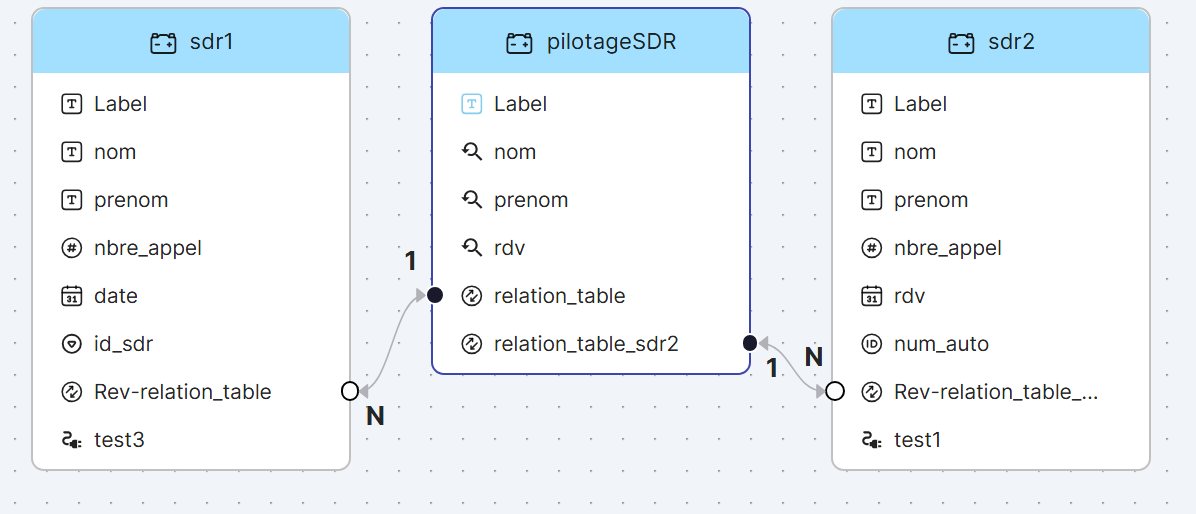
The current behavior works correctly for each relation taken individually, but the data remains siloed by relational source.
My actual need is as follows:
I am looking to build a multi-board consolidation logic that allows aggregating elements from several boards sharing the same schema.
Specifically, I would like to know if there is in Suivi:
- a mechanism to merge several relations into a single logical view;
- a logic equivalent to a UNION operation between several boards;
- or a way to centralize the results of several lookups into a single column or relation.
The objective is to be able to utilize sdr1 and sdr2 as a single consolidated source in pilotageSDR, rather than as two independent relations.
In a relational database context, the need would be similar to a consolidated view or a multi-source aggregation.
Thank you in advance for your help.
2 Likes
Hello Llyodore,
Thank you for your message, the use case is very clear. Relationships and lookups do allow retrieving information from a linked board, but each relationship remains independent.
In your case, since sdr1 and sdr2 seem to have exactly the same data schema, I would advise you to slightly revise the modeling by combining the two sources into a single SDR board.
The idea would be, for example:
-
a single SDR board containing all the rows;
-
a tag-type field, for example Team, Source or Scope, with the values SDR1 and SDR2;
-
a consolidated view for global management;
-
filtered views to show only data from SDR1 or SDR2;
-
a portal with different pages/views and adapted rights to give each population access only to its scope.
This would allow maintaining a single exploitable data source for management, while retaining the ability to compartmentalize uses by view and by access rights.
In summary: if the two boards represent the same structure, it is better to model them as a single board enriched with a segmentation field, rather than as two separate boards to be consolidated later.
Thank you again for your question; it’s typically the kind of concrete use case that enriches discussions on the forum. Feel free to share other questions, feedback, or best practices; it benefits the entire community!
1 Like
Hello Alexandre,
Thank you very much for your feedback, I better understand the proposed logic.
In my use case, I will gradually integrate new prospecting lists/campaigns. It is precisely for this reason that I want to segment my data by boards rather than centralizing everything in a single SDR database.
I’m afraid that in the long run, a single board will become difficult to maintain and manage with the increase in volume and sources.
I will therefore try to explore another approach to maintain this segmentation while building a consolidated management view.
Thanks again for the clarifications regarding the current limitations of relations/lookups! 
Thanks for your feedback, Llyodore.
Yes, you can absolutely experiment with several approaches, and that’s often how you find the right modeling in SUIVI.
What I would simply keep in mind is that if your new prospecting lists/campaigns maintain an equivalent data structure, then keeping them in separate boards risks creating complexity later on: duplicate relationships, separate lookups, manual consolidation, more difficult-to-maintain steering views, etc.
From experience, in this type of case, the most robust modeling remains rather:
-
a single prospecting board;
-
a segmentation field to distinguish campaigns, lists, SDRs, or any other scope;
-
filtered views for operational uses;
-
a global view for consolidated steering;
-
and, if necessary, a portal to manage access to the right views according to profiles.
This allows each team to work on its scope, while maintaining naturally structured and consolidable data.
Afterwards, don’t hesitate to test different ways of doing things: depending on the expected level of compartmentalization, the volume of data, or future uses, certain variations can be defended. But if the objective is indeed to obtain a clean and maintainable consolidated vision, I would really favor the single board approach with segmentation.
1 Like
Thank you very much for your feedback!
I will try to rethink the single board approach with segmentation!
Upcoming AI agents should greatly help with consolidation.