Hello,
Today it is impossible for me to delete a user who is no longer part of the company:
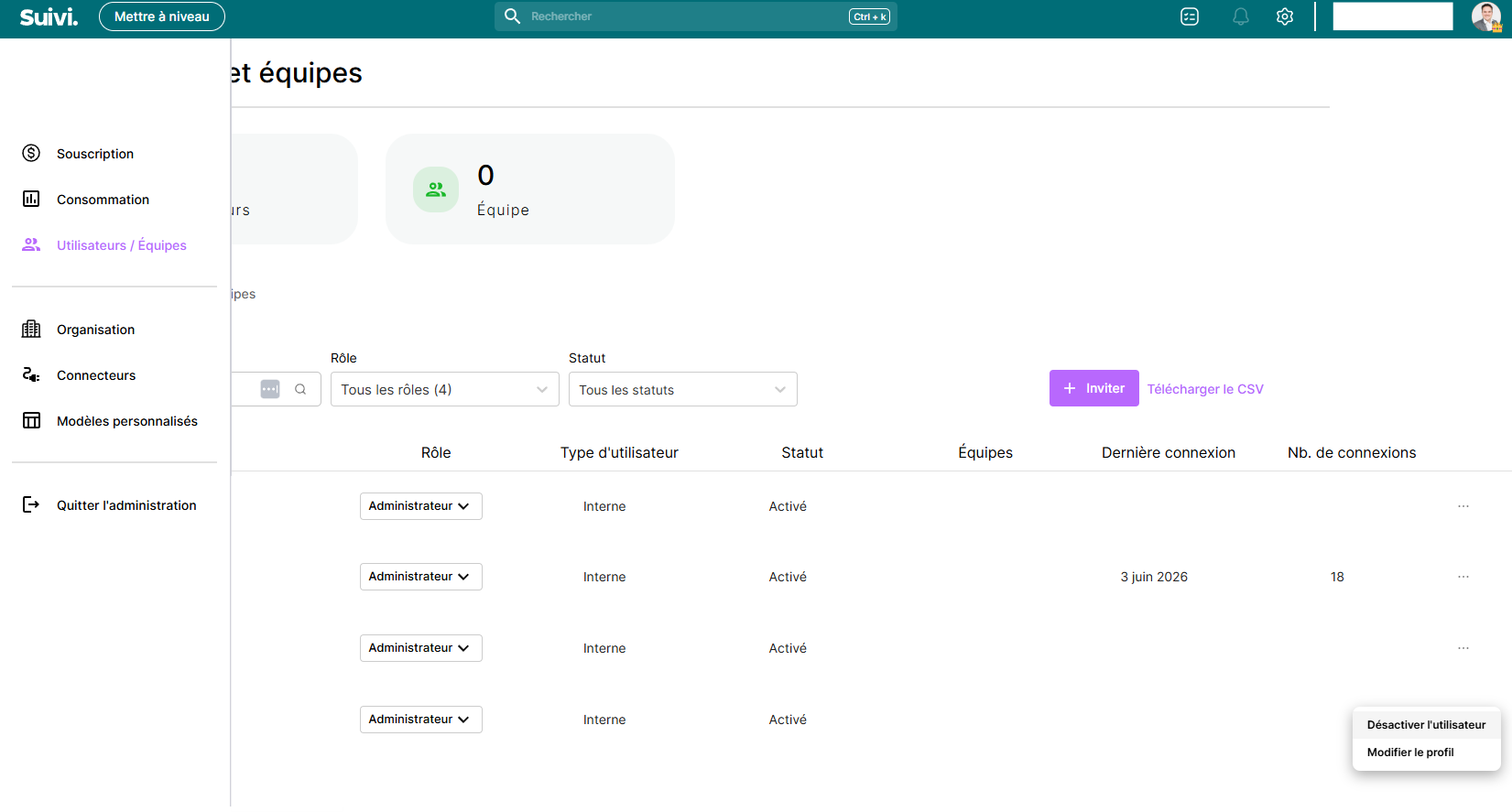
I can only deactivate them.
Is this intended behavior?
Thank you,
Hello,
Today it is impossible for me to delete a user who is no longer part of the company:
I can only deactivate them.
Is this intended behavior?
Thank you,
Hello @antoine.saintoyant
Thank you for your question.
The current behavior is indeed the expected one: in Suivi, a user is not permanently deleted; they can be deactivated.
This approach allows cutting off their access while maintaining data consistency and history. For example, if the user was assigned to a User type attribute, a checklist, or a milestone, the record of this past assignment is kept instead of losing context.
However, there is an important point to keep in mind: user deactivation is multi-organization. If the same user account is present in multiple Suivi organizations, it will be deactivated in all organizations where that address is used.
This is therefore relevant when a person has left the company and their account used a professional email address: access to this account is then cut off wherever it is present.
On the other hand, if the goal is only to remove access to a specific Suivi organization, without impacting other potential organizations, it is better to use the Ghost role. This role has the same effect on access—the user can no longer access the organization—while retaining a record of their past assignments, but with an impact limited to the current organization.
In summary:
Deactivate the user: to be preferred when the account should no longer access any Suivi organization.
Change the user to a Ghost role: to be preferred when you only want to cut off their access to the current organization, while retaining the history.
Have a good day,
Thanks for the clarification!
So I must have made some mistakes 
Sorry @Matthieu_PAYET
However, it can be dangerous because when we are invited to a client’s tenant, they can deactivate us everywhere…
